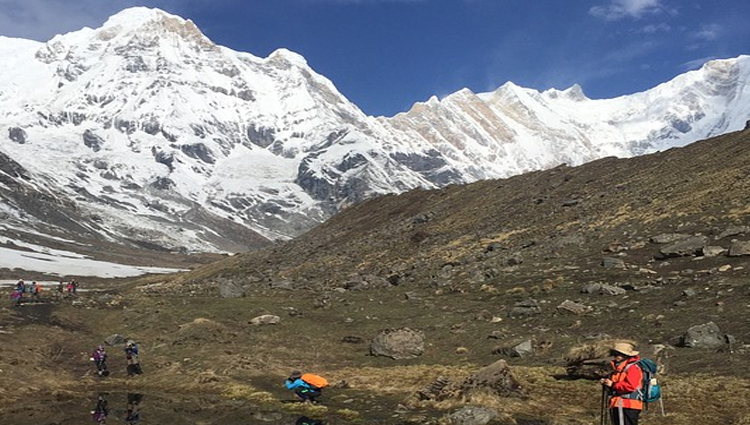
Annapurna and Chulu West Peak

Chulu West is located north of Manang and the Annapurna range. It is a prominent peak in the Manang Himal range, rising majestically from the semi-arid flatlands of the Manang valley. Technically harder than the other climbs described here, it is also a longer climb, and usually two high camps need to be established.

After preparations in Kathmandu, we travel by private vehicle to Besisahar to commence trekking anti-clockwise on the Annapurna Circuit.

We follow the main trail to Manang, walking first through the lush lowlands of the Marsyangdi River and noticing the landscape change as we curve behind the Annapurna range and enter its rainshadow.

A little further on at Letdar (4200m), we  branch away from the main track and and  head towards the Chulu Himal. Chulu West  Base Camp (4700m) is in a narrow valley  about 3 hours from Letdar, up a steep  grassy slope and scree. Here we will spend  some time resting, acclimatizing, and  becoming familiar with the climbing  techniques and equipment we will need to  be successful on ascent.

It is a long climb, and we allow ourselves several days for our assault on the summit.

The first high camp on the mountain is established at 5300m, and a second at 5650m. Summit day demands a special effort, but our prize is a magnificent view of the entire Annapurna range, Manaslu (8163m), and the wild landscape of Tibet.

On descent, we return to the Circuit track at Letdar and then continue over the Thorung La (5416m) to reach Jomsom.

We take a flight from here, back to Pokhara for a night to celebrate our achievement, and finally return to Kathmandu.

Gokyo/Everest Base Camp & Island Peak

Island Peak, also known as Imja Tse, is in the upper Everest region, lying virtually in the shadow of Everest and the dominating Lhotse and Nuptse walls. The mountain was named ‘Island Peak’ due to its striking location in the middle of the Chhukung valley, like an island on a sea of ice. It was renamed ‘Imja Tse’ in the early 80s, but its original name is still more popular.

Technically, it is a slightly more difficult climb than Mera Peak, although lower in altitude. This trek also incorporates Everest Base Camp and Kala Patar as part of the acclimatization process. Most accommodation on this trip is lodge based, but we will need to camp at Island Peak base camp and beyond.

After exploring Kathmandu, we fly to Lukla and commence trekking up the popular well-worn trail towards Namche Bazaar. Ascending gradually, with rest days to help us acclimatize, we take in the beautiful and serene Thyangboche Monastery, with picture-postcard views of the Everest massif and Ama Dablam. Continuing, we reach Dingboche, Lobuche and Gorek Shep. We visit the historical site of Everest Base Camp, and scale Kala Patar(5545m) for more brilliant views of Everest and her surrounding peaks.

By now well acclimatized, we drop back down to Dingboche and then proceed in an easterly direction along the Chukhung valley. Our last lodge is at the Chukhung seasonal settlement; from here it is a 3 hour walk to Island Peak Base Camp (5090m), where we set up our tents. A day’s instruction on climbing techniques will be given either at Chukhung or Base Camp.

The ascent to high camp (5700m) is steep and dusty but not particularly difficult. We retire early that night, and start for the summit by torchlight around 4am. The first leg involves climbing a rocky section over boulders, until we reach the snow slopes.

Donning appropriate gear (crampons, harness etc) and using fixed ropes where necessary, we traverse the crevassed glacier, coming to a steep snow and ice ramp towards the end requiring the use of prussics or jumars to ascend. Finally there is a ridge-line to walk, to reach the summit.

Our reward is tremendous sense of achievement as we survey a breathtaking view: Lhotse Shar(8400m); Makalu(8463m) in the east; Baruntse(7201m); Ama Dablam, Thamserku & Tawoche in the southeast; and a stunning close-up of the of Lhotse and Nuptse rockwall (the longest rock face in the world).

On return we retrace our steps back to Lukla. We spend an evening of celebration with our Sherpa crew, before flying back to Kathmandu.

Mera Peak and Hinku Valley

Mera Peak rises 12 km to the south of Mt Everest, dominating the remote and beautiful Hinku Valley. It has 3 distinct summits. We ascend Mera Central via a long broad ridge from Mera La pass on the northern face. A high camp is established at 5800m. All accommodation on this trip is tent camping.

After making preparations in Kathmandu we fly to Lukla, and then head into the Hinku valley. We trek for several days, through rhododendron, fir and silver birch forests, to reach our camp at Tagnac and a well-deserved rest day.

Along the way, we will see the devastation caused in 1998 when the wall of the Sabai Tsho, a glacial lake, broke and flooded the valley. We will also catch our first glimpses of Mera from the south, with all 3 peaks visible.

From Tagnac, we ascend to camp at Khare, the last seasonal settlement in the Hinku at 5000m. At Khare, we are at the base of an immense glacier leading to the Mera La pass. We spend a day learning the theoretical and practical techniques for the climb ahead, ascending onto the glacier to practice and to further acclimatize.

Next day we push on, roped together as we move over crevassed terrain, up moderately angled snow slopes to high camp at 5800m.

For our summit attempt, we start by torchlight in the early morning (sometime between 3-5am). It is a prolonged and steady ascent, with a steep last section to be overcome before we hit the top. Even though the climb is technically straightforward, there are some crevasses to manoeuvre and the route can be long and demanding after a fresh snowfall.

The 360 degree summit view is just stunning. Visible are 5 mountains over 8000m: Everest(8848m), Kanchenjunga(8586m), Lhotse(8501m), Makalu(8463m), and Cho Oyu(8201m). You will also see Baruntse, Ama Dablam, Chamlang and many others.

On return, we take a shorter route via Zatra La back to Lukla to celebrate our achievement with our Sherpa crew, before flying back to Kathmandu.

Mera Peak and Amphulapcha Pass

This special trip is one of our most challenging expeditions. From the mystical city of Kathmandu, we trek through three different valleys (Hinku, Hunku and Khumbu), negotiate three high passes (Zatra Wala 4580m, Mera La 5400m, and Amphulapcha 5845m), and climb the popular Mera Peak. Accommodation on this trip is all tent camping.

From Kathmandu we take a flight to Lukla, and commence our trekking journey. Our trail is immediately quite steep, towards the Zatra Wala pass which will take us into the Hinku Valley. Since we must briefly rise to 4580m to cross the pass, our first few trekking days are short with plenty of rest stops, to patiently keep our bodies comfortable with the altitude gain.

Over the pass, we descend into the Hinku valley, which is then followed northwards. The 3 distinct peaks of Mera will be visible in the distance as we progress through rhododendron, fir and silver birch forests. Again, the pace is taken slowly, with a rest day at Tagnac to ensure thorough acclimatization.

From Tagnac, we ascend to our base camp at Khare. Here we have a day’s instruction on climbing technique, and move up onto the immense Mera glacier for some practice and further acclimatization. Our attempt on Mera Peak will be launched from a high camp above Mera La at 5800m. A long, broad ridge is followed from the pass towards Mera Central, involving a sustained effort up a moderate snow slope. Slow and steady is the way to go, remembering that the view from the summit is stunning. Everest, Kanchenjunga, Lotse, Makalu, Cho Oyu, Chamlung, Baruntse, Nuptse, and many more Himalayan giants will be on full display, and you will feel a wonderful sense of achievement.

After summitting Mera, we continue over Mera La and drop into the completely unpopulated Hunku Valley. This wide, open valley is a truly wonderful, wild and remote place, rarely visited by trekking groups. For several days we walk northwards, encountering many glacial lakes which are likely to be frozen solid allowing us to walk right over the top of them. Our last camp spot before the pass is at Panch Pokhari (5 lakes), an exposed alpine expanse where you feel awed and humbled by your amazing surrounds.

Amphu Lapcha is a difficult and demanding pass, but guides will be there to help and encourage you the whole way. We start by climbing up rocky scree, approaching some magnificent pristine glacial formations. Ice steps may need to be cut, and ropes fixed, to assist everyone up onto the glacier. Depending on conditions, crampons may be needed to climb the final snow slope to the narrow pass itself.

The view from here simply provides some of the most superbly wild, unspoilt, breathtaking alpine scenery imaginable, and we are unlikely to have seen any other trekkers since leaving Mera La. The descent is steep and, depending on conditions, may involve being belayed part of the way down. Our campsite at the end of a challenging but exhilarating day is a lovely sheltered grassy area, a welcome spot for a rest.

From here, we descend to Chukhung and then into the Khumbu valley. Our itinerary takes in the beautiful Thyangboche Monastery and the colorful town of Namche Bazaar, before we finally arrive back at Lukla.

Langtang Valley and Yala Peak

The Langtang region is the closest to the Kathmandu valley, yet sees less visitors than the Annapurnas and Everest. Langtang National Park is noted for its diversity of wildlife, gorgeous alpine forests and flowers, and of course the mountain scenery is just as dramatic. We stay in comfortable lodges on the approach to the mountain and camp for the duration of the actual climb.

From Kathmandu, we take a coach ride to Syabru Besi, on the Langtang Khola river. After lodging here for the night, we commence our approach trek, travelling for several days up the Langtang Khola Valley through bamboo forests and beautiful woodlands where Langur monkeys may be seen in the trees.

We gradually reach Kyanjin at 3800m. To aid acclimatization, we ascend Kyanjin Ri (4773m), and receive instruction on safe climbing techniques. From Kyanjin we depart from the main trail to commence the camping section of the trip, walking over steep moraines up the Yala glacier to Yala Base Camp.

The following day we wake early to make our summit attempt, involving a glacier walk and an ascent on moderately angled snow. On reaching the summit at 5530m, we will be met with stunning views of Langtang Lirung (7246m), Lenpo Gang (7083m), and other snow-covered mountains in the Jugal range.

On return we retrace our steps to Kyanjin and Syabru Besi for the drive back to Kathmandu.

Mountain Biking in the Himalayas

The Annapurna Circuit is one of the best bike rides in Nepal, offering a unique insight into the physical and cultural diversity of this fascinating country. From Kathmandu we travel by bus to the roadhead of Besisahar, and our ride initially follows the Marshangdi river through rice paddies, terraced fields and Hindu villages which lie in the shadow of the Annapurna and Manaslu ranges. As we ascend, the valley becomes narrower, waterfalls plummet from high above and the scenery takes on a rugged alpine appearance. The trail then bears west behind the Annapurnas to enter the trans-Himalayan region, populated by people of Tibetan origin whose prayer flags, Mani walls and monasteries are constant reminders of the thriving Buddhist culture. There are dramatic views of Annapurna II, Annapurna III and Gangapurna as we make the gradual ascent to the village of Manang. We rest and acclimatize for a day here before undertaking the challenging crossing of the Thorong La (5416m) that links the Marsyangdi and Kali Gandaki Valleys. (The Kali Gandaki river valley is the world’s largest gorge, a staggering 6,000 meters deep). At the top of the pass we savour majestic mountain views before descending to the holy temples at Muktinath. We further descend into the valley at Jomsom at the foot of world’s deepest gorge, cutting between the peaks of Annapurna and Dhaulagiri.

From Jomsom we follow the Kali Gandaki valley. This valley has long been both an important trading and pilgrimage route. The Thakalis, who populate the upper valley, had control of the once-profitable salt trade. Evidence of their wealth can be seen in the ornate construction of their villages, particularly Tukche. Moving south, we re-emerge from the rain-shadow in front of the Annapurna and Dhaulagiri ranges into deciduous forests and fertile lands populated by Gurung and Magar tribes. As we near Pokhara, we again move into sub-tropical terrain populated by Chhetri and Brahmin people. This is a journey of tremendous contrasts, as we ride through different climatic zones and meet many different ethnic groups along the way. This ride is at all times back-dropped by fantastic mountain scenery and is a truly classic ride.

Exciting Paragliding Tours

Adventure Thamserku offers some exciting paragliding tours in Nepal. Paragliding in the Himalayan region is a truly wonderful and fulfilling experience for the adventure seeker. Experience the unparalleled scenic grandeur as you soar over villages, monasteries, temples, lakes and jungle, while sharing airspace with Himalayan griffins, eagles, and kites.

Paragliding is a seasonal sport; the flying season in Nepal commences in March, April, May, September, October and November, the best months being October, November and December. Pokhara is becoming one of the world’s best destinations for tourists to experience the Himalayas and is one of the world’s best locations for Paragliding.

Tandem Flying requires a trained pilot flying with a passenger. It is your solution to experience paragliding without extensive training. Two separate harnesses are attached to the wing. The paragliding harness is designed for comfort and safety. You can sit back, take pictures and enjoy the freedom of flying like a bird. This exciting short flight trip can be completed pre/post trekking when you have a rest day in Pokhara. For details please make an inquiry or book this tandem flight now.

We offer 2 kinds of tandem flights:

Fewa Lake and Mountain view

We take off from Sarangkot, while you are flying you will see the Mountain views, villages, river and lake.

Time:- 25-45 Minute (Dependant on weather conditions)

Cross Country 

Our background will be the Annapurna, Dhaulagiri and Manaslu among others. This flight gives you the chance to have a longer and unique flying experience.

Time: 1-2 Hours

Chitwan National Park

Nepal is one of the world’s best destinations for a Jungle Safari. Journey into deep jungle on an elephant’s back, or take a 4X4 jeep to view wild animals in their natural habitat for a totally unique experience. Tour the lush Jungle in a dugout canoe, gliding silently past a myriad of exotic species or take a bird watching excursion. We arrange Jungle safari trips to Chitwan National Park , Bardia National Park , Shuklaphata Wildlife Reserve and Dhorpatan Hunting Reserve.

Chitwan National Park was the first and most famous of all National Parks in Nepal. It is situated in the foothills in the Inner Terai region bounded by Sivalik Hills. Chitwan National Park is listed in the UNESCO World Heritage Site (natural) List. The main reason for visiting Chitwan National Park is to view the one horned rhino and other tropical wildlife such as leopard, various kinds of deer, sloth bear, wild boar, fresh water dolphin and crocodile. There are over 450 species of birds, and the elusive Bengal tiger. It has often been called one of the finest wildlife experiences in Asia.